
Self-care is something many of us hear about often, yet it can feel unclear or even out of reach when life feels overwhelming.
You may have been told to “take care of yourself,” but what does that actually mean for you?
Self-care is not one-size-fits-all. What restores one person may not feel helpful for another. It is personal, and it often changes depending on what you are going through.
In counselling, this is often one of the first things we gently explore. When life feels heavy, self-care is often the first thing to fall away.
This guide is here to help you pause, reflect, and begin to understand what self-care might look like for you.
What is self-care?
Self-care is not about indulgence or putting yourself above others.
It is about recognising that you have needs - emotional, physical, and psychological - and allowing space for them to be met.
For many people, self-care can feel uncomfortable or even selfish. You may be used to prioritising others, pushing through, or telling yourself to get on with it.
But caring for yourself is not selfish. It is necessary.
The 5 Areas of Self-Care
Rather than thinking about self-care as something you “should” do, it can be more helpful to notice where you might need care and attention.
Psychological self-care (your mind)
This relates to your thoughts, mental space, and how you process what is going on around you.
Taking a break from overthinking
Writing things down to clear your mind
Setting boundaries around mental load
Limiting overwhelm from information or social media
Engaging your mind in something meaningful or creative
Emotional self-care (your feelings)
This is about recognising, allowing, and expressing your emotions.
Giving yourself permission to feel what you feel
Talking to someone you trust
Journalling or expressing emotions in a safe way
Practising self-compassion
Noticing what you might be holding in
Physical self-care (your body)
This is about how you care for your body and physical well-being.
Rest and sleep
Gentle movement
Nourishing your body with food
Taking time to slow down
Noticing when your body needs a pause
Social self-care (connection with others)
This relates to your relationships and sense of connection.
Spending time with supportive people
Reaching out instead of withdrawing
Setting boundaries when something feels too much
Allowing yourself to be supported
Noticing which relationships feel nourishing
Spiritual self-care (meaning and grounding)
This does not have to be religious. It is about connection, meaning, and what grounds you.
Time in nature
Moments of stillness or reflection
Connecting with your values
Doing things that feel meaningful
Feeling part of something bigger than yourself
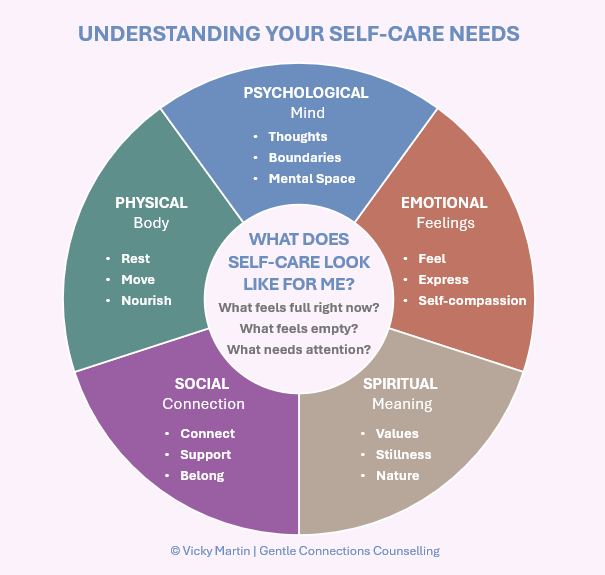
Self-care wheel for managing overwhelm and burnout, covering emotional, physical, psychological, social and spiritual wellbeing.
A simple self-care check-in
You might find it helpful to pause and ask yourself:
What currently feels full in my life?
What feels empty or neglected?
Which area might need a little more care right now?
You do not need to change everything. Small, gentle steps are enough.
Additional areas of self-care
The five areas above cover much of what we need, but you may also notice other parts of your life that benefit from care and attention.
These often overlap with the areas already explored:
Practical self-care – organising daily life so things feel more manageable
Work self-care – setting boundaries and creating balance
Financial self-care – building awareness and reducing stress around money
Personal self-care – reconnecting with yourself and what matters to you
Space self-care – creating an environment that feels calm and supportive
You do not need to focus on all of these. Instead, notice what feels most relevant for you right now.
When self-care feels difficult
If self-care feels hard, you are not alone.
You may:
feel guilty for taking time for yourself
struggle to know what you need
feel disconnected from yourself
find it difficult to slow down
Often, it is not just about knowing what to do, but understanding what is getting in the way.
How counselling can support you
In counselling, we can explore what self-care means for you, at your pace.
Together, we can:
understand what is contributing to overwhelm
reconnect you with your needs
explore what supports you emotionally and mentally
build self-care in a way that feels realistic and sustainable
If you are feeling overwhelmed, burnt out, or not quite yourself, you are welcome to get in touch.
